
AI Overviews vs Your Blog: Why Traffic Dropped, and What Agencies Can Actually Do About It
By Sanjana Ahuja
Three client calls this quarter, same question every time: rankings haven't moved, so why did traffic fall off a cliff? AI Overviews SEO is why. It means optimising content so Google's AI summaries cite it, not just rank it below them, and those summaries already sit above half of tracked searches, cutting click-through by 15% to 58% once one appears.
Your content didn't get worse. It's still ranking exactly where it did a year ago. What changed is the thing sitting above it.
What are AI Overviews?
AI Overviews are Google's AI-generated summaries that sit above the traditional list of blue links. They launched in the US in 2024 following a Search Labs experiment called Search Generative Experience and have expanded steadily since. Per Google's own June 2026 announcement, AI Overviews now has over 2.5 billion monthly active users, with the newer AI Mode surpassing 1 billion.
The mechanism matters more than the definition, and this is the part most explainers skip. Rather than simply returning the ten best-matching pages, Google's systems synthesise an answer from several sources at once, using something Google calls "query fan-out": running multiple related searches behind the scenes and pulling from the results to build one composite answer. That's why a page can start appearing for broader, messier queries than before. It's also why an AI Overview will sometimes cite a source that never ranked particularly well in classic search at all.
Here's the uncomfortable bit nobody puts in the pitch deck: ranking and being cited are no longer the same achievement, and most agency reporting still treats them as if they are.
A page can sit at position #1 and never appear inside the AI Overview. Another page, ranking #7, buried on page one where nobody scrolls, might be the exact one Google's summary quotes word for word. That distinction is now central to AI Overviews content marketing generally, not just to technical SEO. If your monthly client report has a column for average position and nothing for citation rate, you're reporting on last decade's scoreboard.
How Did They Change Your Traffic?
Quite a lot, and the data has only gotten starker over the past year.
A
The Click-Through-Drop-Rate
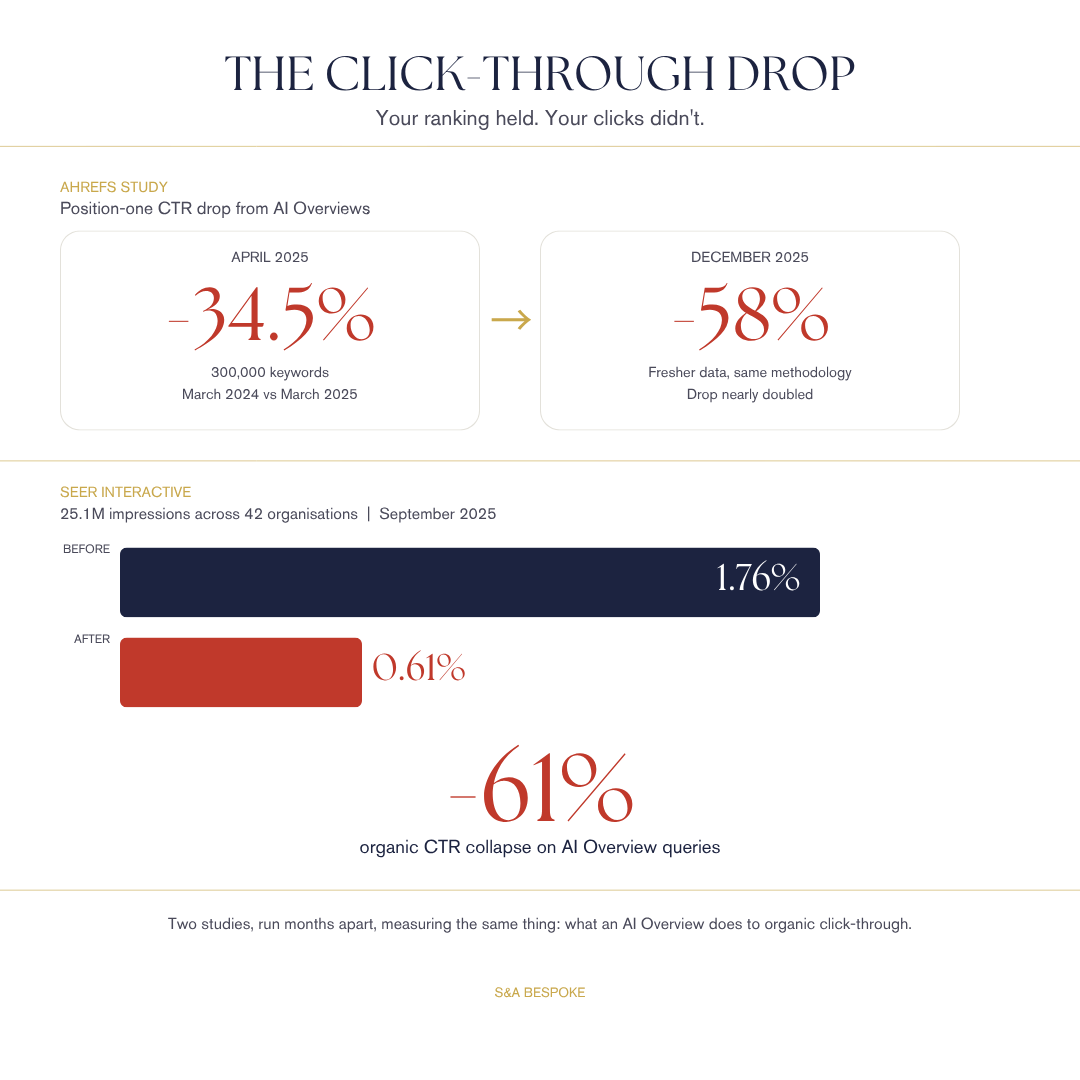
hrefs ran the same study twice. In April 2025, comparing March 2024 to March 2025 across 300,000 keywords, they found AI Overviews reduced click-through rate for position-one content by 34.5%. They reran it in December 2025 with fresher data. The number had climbed to 58%.
Seer Interactive's September 2025 analysis, covering 25.1 million impressions across 42 organisations, found organic CTR on AI Overview queries had fallen from roughly 1.76% to 0.61%.
ew Research Center tracked actual browsing behaviour, not just aggregate keyword data, across 900 US adults and 68,879 searches in March 2025. People clicked a traditional organic result in just 8% of visits when an AI summary appeared, against 15% when it didn't.P
Coverage is spreading faster than the CTR numbers alone suggest. BrightEdge's tracking shows AI Overviews appearing on roughly 48% of tracked queries as of February 2026, up from about 30% the year before. Healthcare queries trigger one around 88% of the time. B2B technology, around 82%. If your client sits in either category, this conversation stopped being optional a while ago.
If a client asks why their AI Overviews traffic dropped specifically on their strongest-performing posts rather than their weaker ones, this is usually why: informational, question-format, and comparison-style queries are precisely the ones AI Overviews target most aggressively. Well-optimised, comprehensive how-to content is exactly what an AI system finds easiest to summarise. Ironically, the posts that used to be your best assets are often the ones absorbing the biggest hit.
There's a pattern worth naming here, because it's counterintuitive: informational, question-format, and comparison-style content gets hit hardest, precisely because it's good. If a client asks why their AI Overviews traffic dropped specifically on their strongest posts rather than their weakest, this is the reason. A well-optimised, genuinely comprehensive how-to post is exactly the kind of page an AI system finds easiest to summarise cleanly. The posts that used to be an agency's proudest work are often the ones absorbing the biggest hit. That's a hard thing to say to a client who spent eighteen months building topical authority on exactly those pages, but it's true, and pretending otherwise wastes everyone's next quarter.
Search Console has been playing catch-up on all of this.
For two years, site owners had no way to isolate AI Overview performance; it was folded into the general "Web" performance report, and John Mueller confirmed that every link within an AI Overview shares a single reported position, regardless of where it actually sits. That changed on June 3, 2026, when Google rolled out dedicated Generative AI performance reports in Search Console, initially available to a subset of UK site owners. The catch: impressions only. No clicks, no CTR, no query-level data. You can now see that your page appeared inside an AI Overview. You still can't see whether it did anything for you.
Picture what this looks like on an actual results page.
Type "best CRM for small teams" into Google today, and instead of ten links to click through and compare, you get an AI-written paragraph naming four or five tools, with small citation links tucked into a carousel underneath. The answer arrives before anyone scrolls. Clicking through to any single source is now optional, where it used to be the entire point of searching. "How to switch CRM providers" plays out the same way: a step-by-step AI answer up top, sources cited but rarely opened, and the blog posts that used to own that space now competing for a footnote instead of a click.
Why Blogs Lose Clicks
Three mechanics are doing most of the damage, and they compound each other.
The obvious one first: the summary genuinely answers the question. If a blog post's entire value was "here's a clear, well-organised answer," and Google's AI can now produce that same clear answer directly on the results page, there's less reason to click through. This hits informational, how-to, and definitional content hardest, which happens to be most of what blogs are built on.
Less obvious is what's happened to position itself. Because every citation within an AI Overview appears in roughly the same spot in Search Console, a page can be cited prominently and still show flat or declining click data. The citation doesn't reliably convert to a click the way a top organic listing once did. Rankings can look identical month to month while the thing they're supposed to predict, actual traffic, quietly comes loose from them.
And then there's the part most content teams miss entirely, mostly because nobody wants to say it out loud: being cited is not the same as being clicked, but it's still meaningfully better than the alternative. The citation doesn't restore what search used to give you. But it beats not being there at all by a wide margin, and treating "cited but unclicked" as a failure state will make your reporting look worse than your actual performance.
There's a fourth factor too, and it's the one that should actually change how you plan content. Query fan-out means a single AI Overview might draw from five or six sources to answer one question, several of which would never have ranked high enough to appear together on a traditional results page.
That's a real opening hiding inside the disruption. A specific, well-structured page that would have sat at position #9 or #10, invisible below the fold, now has a genuine shot at citation just by answering one narrow slice of a question especially well. Specific and quotable often beats broad and authoritative, and most content calendars are still built around the opposite assumption.
The 90-day fix Plan
Getting cited, and where possible still clicked, is a learnable skill. Here's a realistic sequence.
Month one is about finding out where you actually stand.
Days 1 to 30: pull your top 50 informational keywords from Search Console and cross-reference them against those that currently trigger an AI Overview, using either the new Generative AI performance report or a third-party SERP tracker like Ahrefs or Semrush, since Search Console's own data is still impressions-only. Flag which pages are cited within those overviews and which are simply sitting underneath, present but ignored. This one exercise usually reframes the whole traffic conversation for a client.
Once you know where you stand, month two is rewriting.
Days 31 to 60: move the direct, complete answer to the first two or three sentences on every flagged page. Break long explanatory paragraphs into sections that could stand on their own as a quoted answer. Swap generic claims for real, named data and sources, since AI systems consistently favour specific, attributable evidence over vague authority. Add FAQ sections written as literal question-and-answer pairs, marked up with the FAQ schema, so the structure is machine-readable rather than just visually obvious to humans.
The final month is where you stop chasing every query equally.
Days 61 to 90: some content categories, comparison queries, "near me" searches, and question-format queries, especially, are now so AI Overview-saturated that click volume simply isn't returning to pre-2024 levels. For those pages, stop optimising for clicks and start optimising for citation frequency and brand visibility instead. This is also the moment to lean harder on channels less exposed to all of this: email subscribers, LinkedIn thought leadership, and commercial or transactional pages, which still trigger AI Overviews far less often than informational content does. Re-run the audit at day 90 and compare citation rates, not just click totals.
We've put the same plan into a printable, tickable version your team can work from directly: Download the 90-Day AI Visibility Roadmap.
Also download the associated AI Overview visibility checklist.
FAQs
What is AI Overviews SEO? AI Overviews SEO is the practice of optimising content so it gets cited inside Google's AI-generated search summaries, not just ranked in the traditional list of organic results below them.
Why did my traffic drop if I'm still ranking well? Ranking and citation are separate outcomes. Your page can hold its position while an AI Overview answers the query directly above it, reducing the reason for anyone to click through at all.
Can I track AI Overview performance in Search Console? Partially. Since June 2026, Search Console has offered a dedicated Generative AI performance report, but it currently shows impressions only, with no click, CTR, or query-level data yet.
Will my clicks ever recover to pre-AI Overview levels? For most informational queries, unlikely, based on current data. The realistic goal is to earn citations and clicks within the new structure, not to restore the old one.
Does getting cited in an AI Overview actually help if people rarely click the citation links? Yes, relatively speaking. Seer Interactive's research found brands cited inside an AI Overview earned 35% more organic clicks than brands mentioned but not cited in the same summary. It doesn't restore pre-2024 traffic, but it consistently outperforms the absence of a citation.
Which content types are least affected by AI Overviews? Transactional and commercial queries, things like "book," "buy," "near me," or branded searches, still trigger AI Overviews far less often than informational or comparison queries, and generally retain more click-through value.
Is This Actually Worth Disrupting Your Content Calendar Over?
Yes, and probably sooner than feels comfortable. AI Overviews SEO isn't a new trick to chase. It's an admission that "ranking well" and "being seen" have quietly split into two separate jobs, and most agencies are still budgeting, reporting, and planning as if they're one.
The agencies handling this well are the ones who've stopped treating the rewrite work as optional, and started reporting citations the same way they've always reported rankings: as a number that gets checked, argued about, and defended in every client meeting from here on. Everyone else is still measuring a version of search that's already partly gone.
If you don't know which of your top keywords already trigger an AI Overview, or which of your pages are actually cited versus just ranked underneath one, that's the audit worth running before the next content calendar gets built. Book a 90-day AI Overview audit, and we'll show you exactly where you're losing clicks and which pages are worth rewriting first.
Related resources: AI Overview visibility checklist for a printable audit version of the plan above, and our SERP layout infographic, which breaks down exactly where citations now appear on the page.
