

Stop Writing Normal Blog Posts: The AI-Ready Article Blueprint for 2026
By Zaid Malik
For years, marketers obsessed over what to write. In 2026, the bigger problem is how it's organised. Plenty of articles contain useful insights, yet never become the source AI systems quote because the information is buried inside a format designed for humans alone.
An AI-ready article blueprint is a framework for structuring content so AI systems can identify, understand, and cite it without compromising the reading experience for people. The goal isn't to write for algorithms—it's to make expertise easier to extract, easier to trust, and easier to navigate.
As Google AI Overviews, ChatGPT, Perplexity and other AI-powered search experiences answer more questions directly inside their interfaces, visibility isn't determined solely by rankings anymore. It's determined by whether your content can be understood, segmented and confidently referenced. Normal blog posts weren't built for that.
What Is an AI-Ready Article?
An AI-ready article is content intentionally structured so both humans and AI systems can understand it quickly. Rather than presenting one long narrative, it breaks knowledge into logical, self-contained sections that answer specific questions while preserving a coherent reading experience.
Traditional SEO focused heavily on keywords and backlinks. Today's AI-powered search experiences also evaluate how clearly knowledge is organised. Can an AI confidently identify the definition? Does one section answer one question? Can a paragraph be quoted without requiring surrounding context? Those questions increasingly influence whether a page becomes part of an AI-generated answer.
An effective AI-ready blog structure typically includes a descriptive title, a direct answer near the beginning, question-led headings, self-contained sections, concise definitions, frameworks, practical examples, relevant entities and contextual internal links.
Google continues to emphasise helpful, people-first content. In 2026, those same qualities also make content easier for AI systems to interpret and cite. This is why the conversation has shifted from simply publishing more content to publishing content with a deliberate AI-ready content layout.
Why Does Article Format Matter More in 2026?
AI search hasn't replaced traditional search—it has changed how information is surfaced. Google's guidance on creating helpful, reliable, people-first content continues to emphasise that content should be written for people rather than search systems. That principle hasn't changed in the AI era. What's changed is how content is surfaced. Recent analyses of Google AI Overviews show that informational queries increasingly trigger AI-generated summaries, making article structure just as important as the information itself.
Instead of asking "Can we rank for this keyword?", content teams increasingly need to ask, "Can an AI confidently identify, extract and quote this section without losing its meaning?" That's the shift modern editorial teams are designing for.
Another important shift is that AI systems increasingly surface individual sections of an article rather than expecting users to read the page from beginning to end. A well-structured definition, checklist or comparison table can appear independently inside an AI-generated response while still encouraging readers to explore the original source. That makes every section responsible for carrying its own context and value.
In practice, this means editorial teams should think less about writing long, uninterrupted narratives and more about creating clearly organised knowledge. Readers benefit because information is easier to scan, while AI systems benefit because each section communicates one idea without unnecessary ambiguity.
We aren't moving from blogging for clicks to blogging for rankings. We're moving from blogging for visibility, citation and authority. That's why many editorial teams are now reviewing articles against both Google's helpful content guidance and internal publishing standards before they go live.ann
How Should the Page Be Structured?
If there's one section worth bookmarking, it's this one. Most articles don't fail because the ideas are weak—they fail because the ideas are difficult to extract. A human reader may happily read a 2,000-word article from beginning to end. AI systems instead identify sections, determine whether they answer a specific question and decide whether they're reliable enough to reference.
The goal isn't to break your writing into tiny fragments. It's to organise your expertise so every important insight stands on its own while still contributing to a coherent narrative.
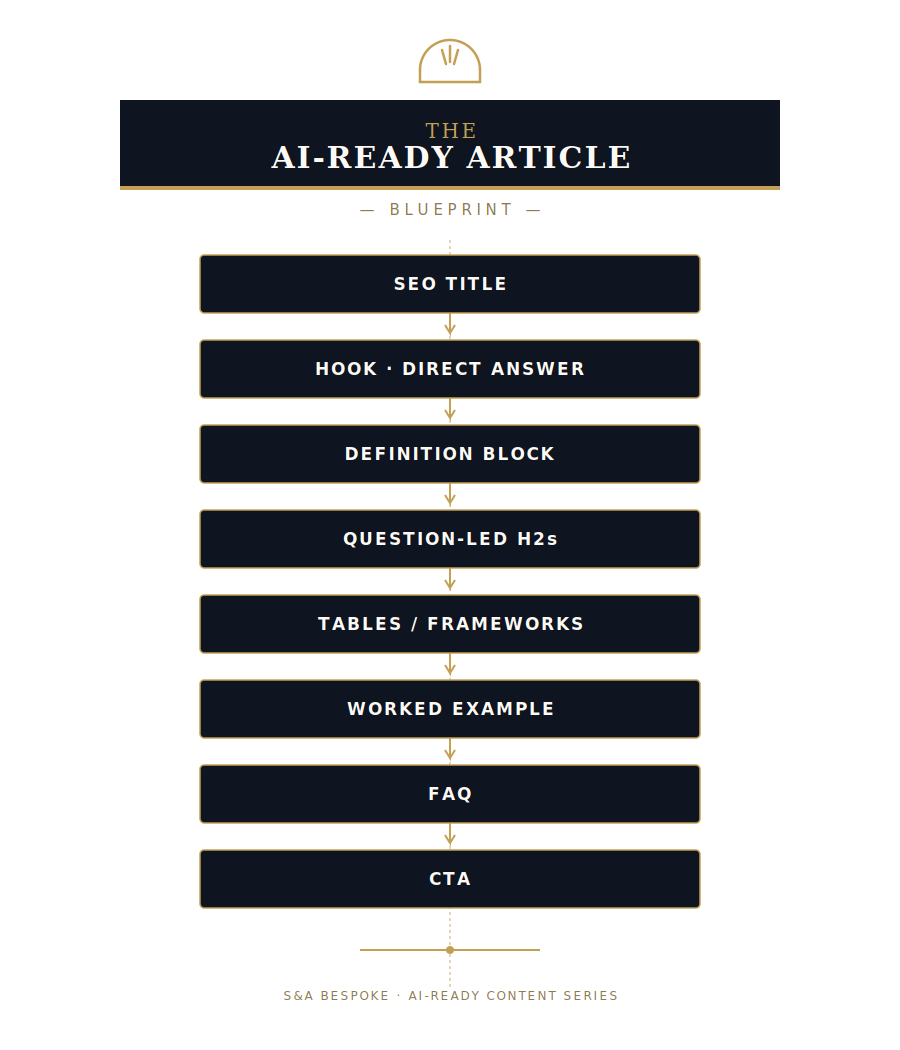
The 8-Part AI-Ready Article Blueprint
Start with a descriptive SEO title and H1 that clearly state the topic and outcome.
Answer the main question immediately in the opening 40–60 words.
Add a concise definition block early in the article.
Organise the page around question-led H2 headings.
Use tables, frameworks, comparison charts and checklists to simplify complex ideas.
Show your work through examples, annotated layouts or practical scenarios.
Include an FAQ that answers logical follow-up questions.
Finish with a CTA that naturally matches the reader's stage in the journey.
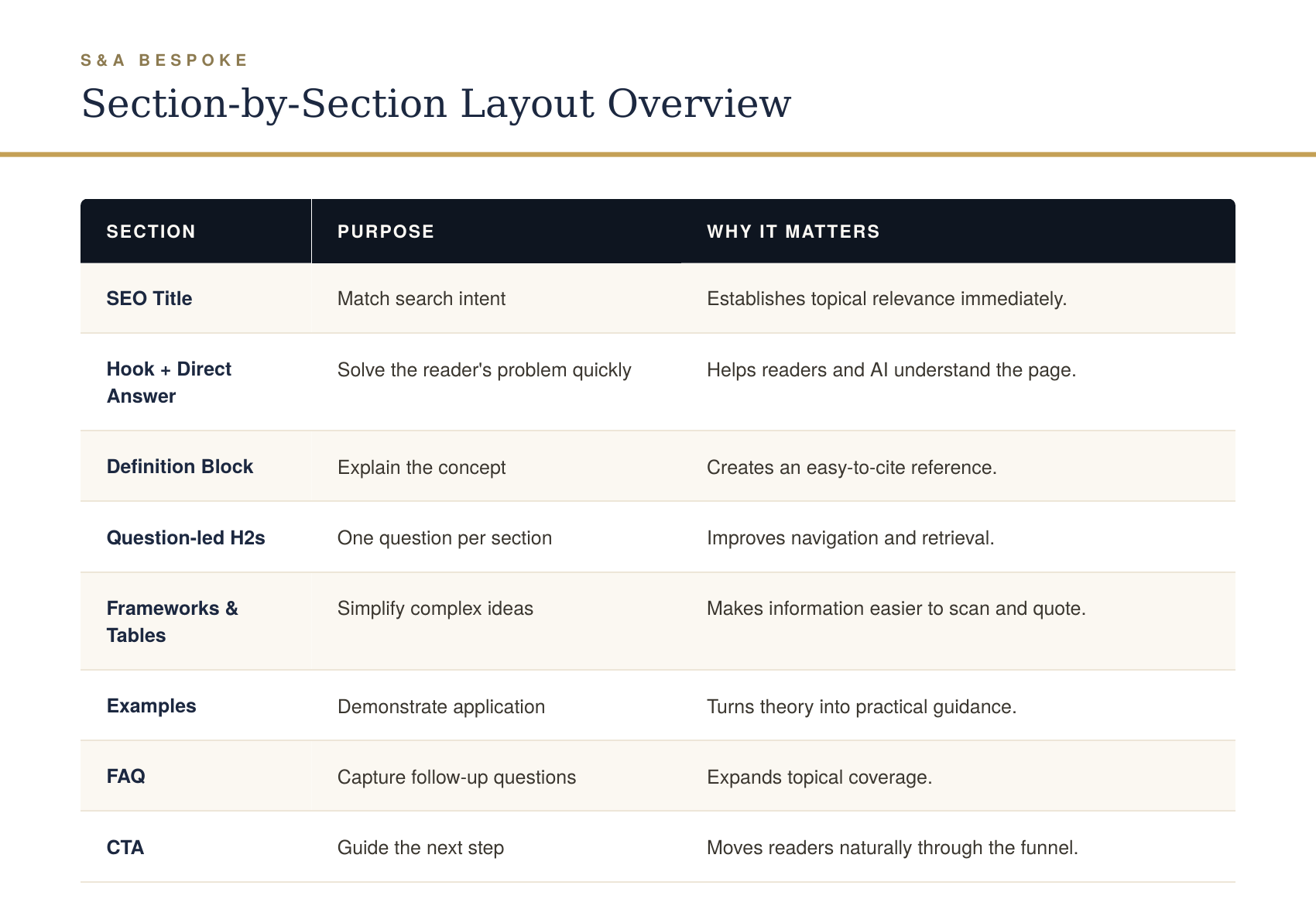
Section-by-Section Layout Overview
Annotated Before vs After Layout
Before: Title → Long introduction → Broad headings → Large text blocks → General advice → Contact us.
After: SEO title → Hook + direct answer → Definition → Question-led H2s → Framework table → Practical example → FAQ → Contextual CTA.
The difference isn't cosmetic. Every structural change reduces friction. Readers find answers faster, while AI systems can extract complete, self-contained explanations without relying on surrounding paragraphs. Better structure improves communication first—and AI visibility follows.
Suggested visual: a ‘Layout at a Glance’ infographic showing the eight-part blueprint alongside an annotated before-and-after wireframe.
What Common Mistakes Make Articles AI-Unready?
Most articles don't become AI-unready because they're poorly written. They become AI-unready because they're organised around how writers like to write rather than how readers and AI systems consume information.
Mistake #1: No Question-Led Headings
Headings should answer real user questions. Clear questions make sections easier to understand, navigate and cite.
Mistake #2: Walls of Text
Break large blocks into shorter paragraphs, lists and tables. Structure improves readability without sacrificing depth.
Mistake #3: Burying the Answer
Answer the main question immediately, then expand with context and supporting detail.
Mistake #4: Weak Topic Focus
One article should solve one primary problem well. Use internal links instead of forcing multiple topics together.
Mistake #5: Advice Without Proof
Support ideas with frameworks, examples, annotated layouts or practical scenarios rather than generic recommendations.
Mistake #6: No FAQ
Anticipate follow-up questions so readers don't need to leave the page for additional context.
Mistake #7: Thin or Derivative Content
Offer original thinking, processes or perspectives instead of repeating widely available advice.
Mistake #8: No Internal Linking
Connect related resources to build topical authority and guide readers naturally.
What Should You Check Before Publishing?
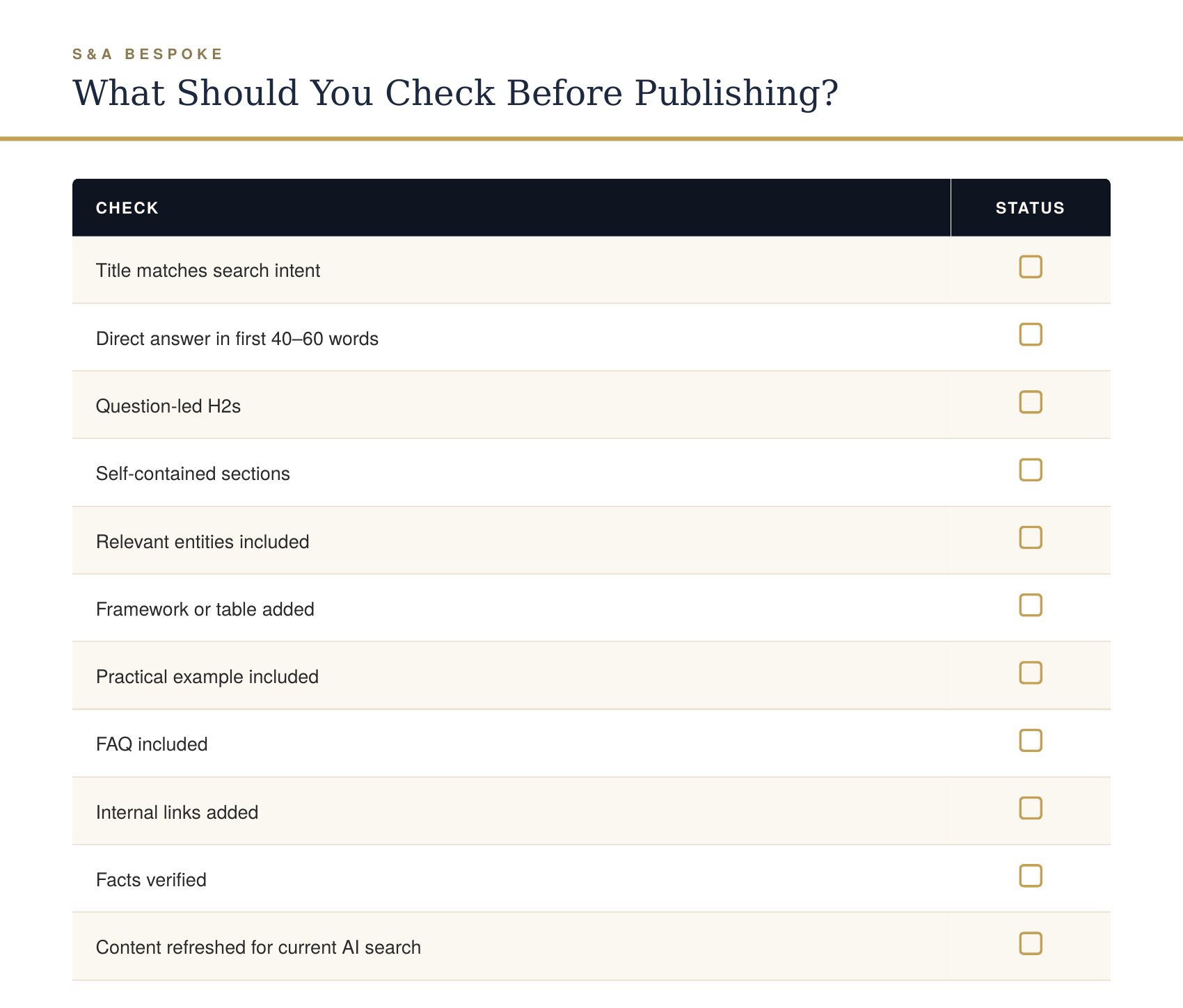
Download the Pre-Publish Checklist_SnA Bespoke here.
Frequently Asked Questions
What is an AI-ready article?
A page intentionally structured so AI systems and people can understand, navigate and reference it easily.
How is this different from traditional SEO?
It combines classic SEO fundamentals with information architecture designed for AI-powered search.
Do I need to sacrifice readability?
No. Better structure improves the experience for both readers and AI systems.
What's the fastest way to improve an existing article?
Rewrite the introduction, use question-led headings, add a definition, framework and FAQ before expanding the copy.
How often should content be refreshed?
Review cornerstone articles regularly as AI search behaviour evolves.
Download the AI-Ready Article Blueprint Template to review your existing articles,
or request an AI Content Layout Audit to identify structural improvements that can increase clarity, authority and AI visibility.
