

GEO vs SEO: What's Actually Different and What Isn't
By Amala Roy
Half your business prospects think GEO replaces SEO entirely. The other half think it's the same output with a trendier name slapped on the invoice. Both are wrong, and the gap between those two beliefs is probably why your website doesn’t have traction.
GEO and SEO, contrary to popular belief, overlaps to a great extent. Both depend on certain fixed criterias such as technical health, structured content, and real topical authority. Where they differ is the end result: SEO is built to win a ranking position on search engines for a person to click on. GEO is built to get a mention inside an AI-generated answer, click or no click.
What Stays the Same Between GEO and SEO?
A site can not score a good GEO score if it’s SEO score lags behind. If a site's technical SEO is weak, no amount of GEO manoeuvering fixes it. AI answer engines still need to crawl, parse, and trust a page before they can pull from it, which means the fundamentals documented in Google Search Console (traditional SEO) still apply almost unchanged.
Here’s what carries over directly:
Crawlability and indexing. If a page isn't indexed, it can't be cited, quoted, or surfaced by anything — search engine or AI model.
Site speed and technical hygiene. Slow, broken, or poorly structured pages get deprioritized by both systems.
Topical depth over keyword-stuffed pages. A single keyword-stuffed post has never outperformed a site that covers a subject thoroughly because readability matters as much as SEO/GEO.
Signs of trust and expertise. Author credibility, accuracy, and a site that doesn't read like it was assembled overnight matters, since AI systems are built to flag inconsistency and shabby work.
Freshness. Content that reflects current, up-to-date information continues to be favored, especially in categories where the underlying technology (LLMs) is moving fast.
If your SEO program has always been built on genuine expertise rather than showy keyword games, you're closer to "GEO-ready" than most of the market.
What is Genuinely Different?
This is where the real work is, and it's worth being precise instead of hand-wavy.
The success metric changes
Classic SEO measures position: are you in the top results for a term? GEO's equivalent question is whether your brand, data, or point of view shows up when someone asks an AI system a question in your category. A page can check all the boxes to get cited in an AI Overview and generate zero direct clicks on the web page. This means click-through rate stops being the only number that matters.
Content has to survive being lifted out of context
SEO content is written for a person visiting and scanning the whole page whereas GEO content needs to hold up section by section — a sentence or short paragraph pulled by a model with no surrounding page, no branding, nothing but the words themselves. In practice that means direct answers stated early, claims that make sense on their own, and heavier, technical use of definitions, short lists, and comparison tables instead of long captivating paragraphs.
Authority gets judged on different signals
Google's ranking systems weigh backlinks and engagement patterns heavily. AI systems appear to draw more on a mix of training data, real-time retrieval, and consistency of information across multiple sources — original data and clearly documented expertise seem to carry more weight even without a traditional backlink. Any agency claiming to have the answer to “what exact metric AI search engines use” is overselling, albeit we have a general idea of it.
The comparison shopping happens at different stages
In traditional SEO, a prospect clicks through and compares options on-site. With AI-generated answers, most of that comparison now happens inside the chat interface before anyone visits a cited website. That compresses the top of the funnel and raises the stakes on being accurate and well-represented in that initial AI summary.
Two Scenarios: What Wins Where
Scenario one — traditional SEO. A regional service business (say, a mid-sized law firm) is fighting for local "near me" search visibility. Their buyers are searching with high commercial intent, clicking through multiple results, comparing reviews and pricing pages directly. Local pack rankings, on-page conversion optimization, and backlink-driven authority are crucial and matter the most in this case, an AI-generated summary wouldn’t be the deciding factor.
Scenario two — GEO focus. A B2B software company sells into a category where buyers increasingly start research with an AI assistant, asking broad, comparative questions like "what's the best approach to X problem." The company couldn’t possibly out-rank three entrenched competitors overnight. But by publishing clearly structured, well-defined and consistent explanations of the problem space, they can become the source an AI system pulls from and paraphrases, which matters more in a longer, more considered sales cycle.
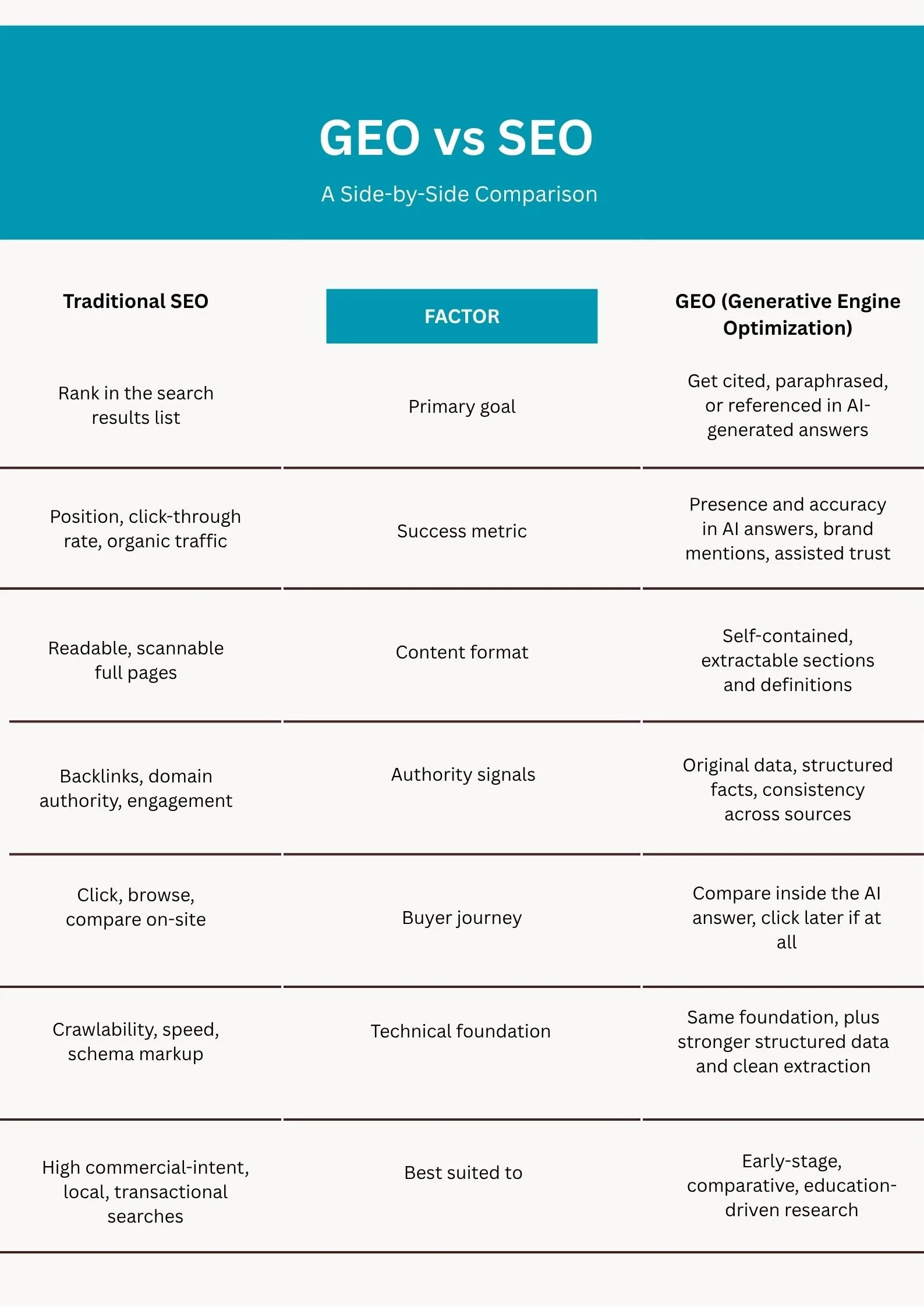
GEO vs SEO
A bird’s-eye view of how traditional SEO differs from the new optimisation on the block - GEO.
The SEO & GEO Playbook for Agencies
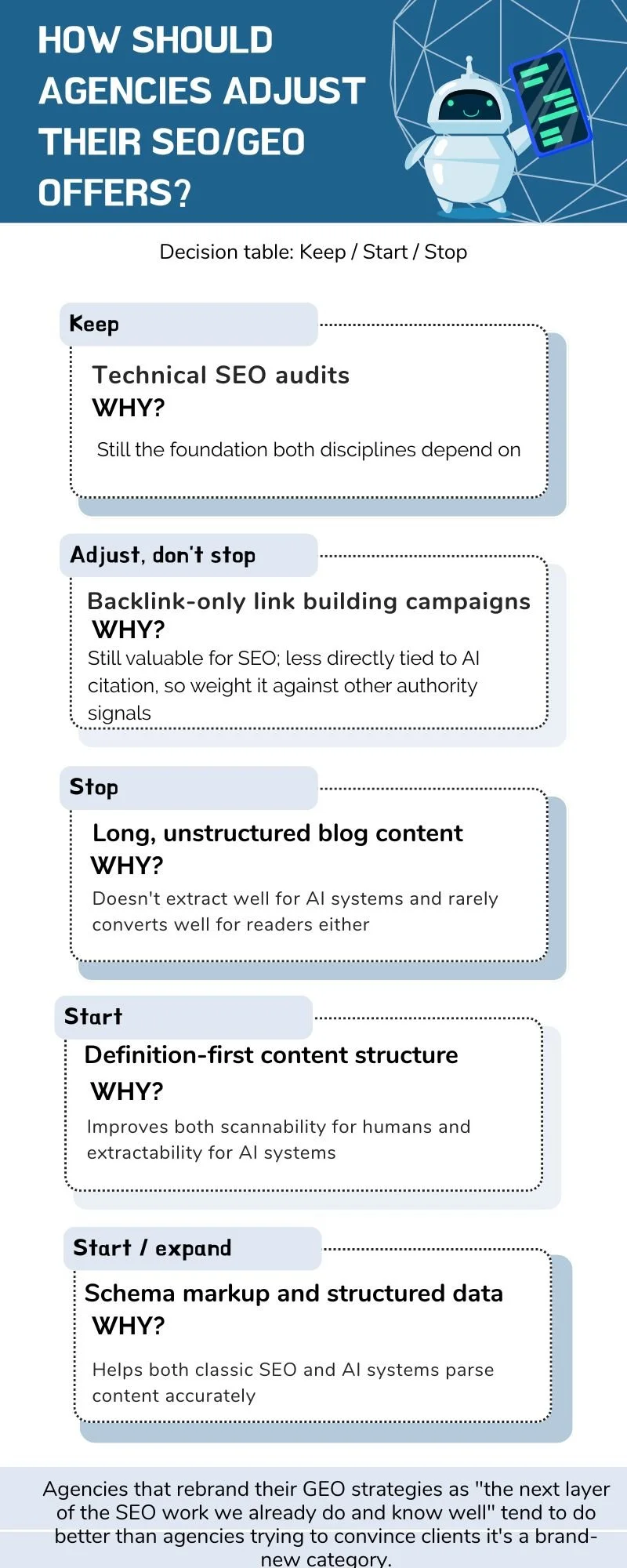
A quick look at how agencies should approach their SEO/GEO plans, based on an in-depth audit of the existing digital visibility.
FAQ
Is GEO the new SEO? No. GEO builds on SEO fundamentals rather than replacing them. A site with weak technical SEO will also struggle with GEO, because both depend on the same crawlable, well-structured foundation.
What's the real difference between generative engine optimization vs SEO? SEO optimizes for ranking position in a search results list; GEO optimizes for being cited, paraphrased, or referenced inside an AI-generated answer. The inputs — structure, authority, freshness — overlap heavily; the output being optimized for does not.
Do I need a completely separate content strategy for GEO? Not a separate strategy, but often a different structure within the same content: clearer direct answers up front, more self-contained sections, and heavier use of definitions, lists, and tables.
How do I know if GEO is working? Track brand mentions in AI-generated answers, monitor referral behavior where platforms provide it, and periodically test your own category's common questions in major AI tools to see what they return. There's no single standardized metric yet — this is genuinely still forming.
Should I stop investing in traditional SEO to focus on GEO? No. For high-intent, transactional, and local searches, traditional SEO still does most of the work. GEO is additive — most valuable for the earlier, more comparative parts of the buyer journey.
Key Takeaways
GEO is what happens when solid content fundamentals get pointed at a new kind of reader: a model deciding what to say on a prospect's behalf. Teams that already do SEO well have a head start. Teams selling GEO as a shortcut around real expertise are going to run into the same wall they will eventually hit with SEO.
Want the shorter version to keep on hand? Download the GEO glossary for quick definitions your team and clients can both work from,
Not sure whether your current content strategy is SEO-strong but GEO-blind — or the reverse? Run it through our GEO vs SEO audit framework to see exactly where your existing content already earns AI visibility, and where the gaps sit before you shift budget around.
